


The William Blake Calendar
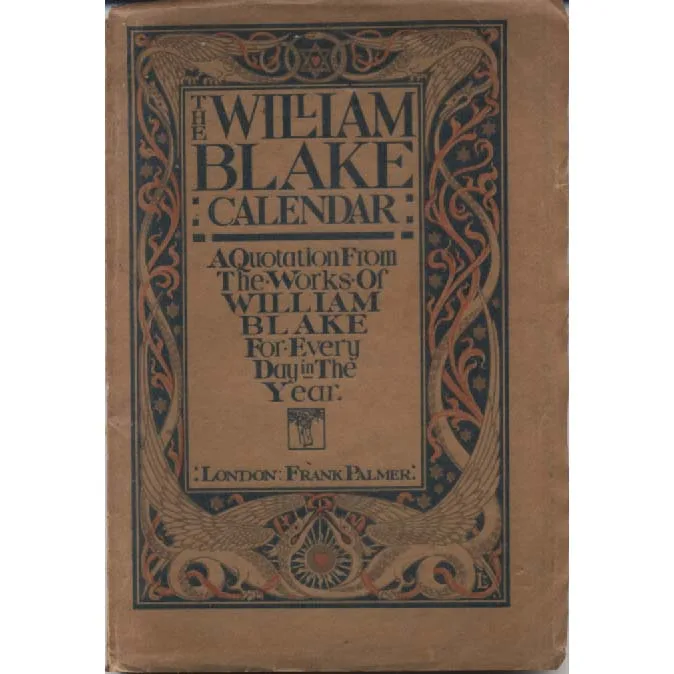
Publisher: Frank Palmer
Format: Paperback
ISBN: none
The William Blake Calendar (1913) – William Blake
Publisher: Frank Palmer, London
Selected by: Thomas Wright
Year: 1913
ISBN: None – published long before ISBNs existed
Condition: Good
Sold by: Crappy Old Books
365 Days of Poetry, Prophecy, Divine Inspiration and the Unsettling Possibility That Reality Is Not Quite What It Seems
Most calendars are perfectly straightforward affairs. They inform us that Monday follows Sunday, February is unreasonably short, and the dentist expects us at half past ten on Thursday. They feature pictures of kittens, attractive landscapes, steam locomotives or occasionally scantily clad celebrities, and their principal purpose is to remind us that time is passing rather more quickly than we would prefer.
William Blake, however, was not the sort of man to be satisfied with such mundane considerations.
Blake saw angels in trees, communicated with spiritual beings, challenged religious orthodoxy, questioned the foundations of society and believed that the human imagination possessed powers extending far beyond the narrow limitations imposed by conventional reason. His universe was populated by visions, prophetic figures, divine energies and cosmic struggles that made everyday Georgian England seem positively uneventful.
Consequently, a calendar devoted to his writings was never likely to resemble something given away by a local insurance broker.
Published in London by Frank Palmer in 1913, The William Blake Calendar offers a quotation from the works of the visionary English poet and artist for every day of the year. The selections were made by Thomas Wright, an enthusiastic student of Blake’s life and writings, who evidently concluded that the average person could benefit from a daily encounter with one of Britain’s most extraordinary literary minds.
It is a charming, unusual and thoroughly thought-provoking little volume, offering readers the opportunity to spend an entire year in the company of a man who regarded ordinary reality as merely the beginning of the conversation.
And, unlike most calendars, it remains perfectly serviceable more than a century after publication.
January: Abandon Your Conventional Understanding of Existence
William Blake was born in London in 1757, a period when Enlightenment thinkers were enthusiastically promoting reason, scientific investigation and the systematic classification of practically everything.
Blake was not entirely persuaded.
While his contemporaries sought to explain the universe through rational principles and empirical observation, Blake insisted that imagination, spiritual perception and visionary experience were fundamental to human existence.
This did not make him especially convenient company.
He was a poet, painter, engraver and mystic whose works challenged established religious and social assumptions. He produced extraordinary illuminated books in which poetry and visual imagery combined to create deeply personal mythological worlds.
His writings encompass innocence and experience, freedom and repression, divine inspiration, human suffering, political oppression and the eternal struggle between imagination and the forces that seek to constrain it.
Some of his shorter poems are among the most recognisable in English literature. Others are so dense with symbolism and private mythology that even determined scholars occasionally appear to need a stiff drink and a quiet afternoon before attempting an explanation.
Yet Blake’s words possess a remarkable intensity.
A brief passage can suggest an entire philosophy, challenge a cherished assumption or transform an ordinary observation into something charged with spiritual significance.
This makes his writings particularly suitable for the unusual format adopted by The William Blake Calendar.
Instead of requiring readers to undertake an extended expedition through one of his elaborate prophetic works, it presents a small portion of his imagination each day.
Which is probably wise.
Too much Blake before breakfast could result in somebody questioning the nature of existence when they were supposed to be putting the bins out.
February: A Tiger, a Lamb and Several Difficult Questions About God
One of Blake’s most enduring concerns was the relationship between innocence and experience.
In Songs of Innocence and Songs of Experience, he explored contrasting aspects of human existence through poetry that could appear deceptively simple while concealing profound theological and psychological questions.
Consider the familiar contrast between the lamb and the tiger.
The lamb suggests gentleness, vulnerability and innocence. The tiger embodies terrifying energy, beauty and destructive power. Both exist within creation, presenting the awkward question of how such apparently contradictory qualities can emerge from the same divine source.
Blake was fascinated by contradiction.
For him, existence could not be adequately understood through tidy categories of good and evil, reason and emotion, innocence and experience.
Human life was more complicated.
This was an unfortunate discovery for people who preferred their theology neatly organised and their moral questions answered by somebody in an impressive hat.
Blake’s poetry invites readers to examine the tensions within human nature and the spiritual significance of apparently ordinary experiences.
A short quotation from his work can therefore provide considerably more intellectual disturbance than the average inspirational calendar, which generally recommends being positive, smiling more often and believing in yourself.
Blake might suggest that your entire understanding of reality is inadequate.
A rather more ambitious way to begin Tuesday.
March: Thomas Wright Decides That the Nation Needs a Daily Dose of Blake
The selection of quotations for this 1913 calendar was undertaken by Thomas Wright, a writer and literary enthusiast closely associated with the revival of interest in Blake during the early twentieth century.
Wright was involved in the founding of the Blake Society in 1912 and subsequently devoted considerable attention to studying and promoting the poet’s life and work.
His decision to assemble a calendar of Blake quotations reflects the growing recognition of a figure who had not enjoyed universal appreciation during his own lifetime.
Blake died in 1827, having spent much of his career outside the literary and artistic establishment. His unconventional beliefs, extraordinary imagery and refusal to conform to prevailing expectations had made him a difficult figure to categorise.
By the early twentieth century, however, his reputation had undergone a remarkable transformation.
The visionary artist once regarded by some contemporaries as eccentric or incomprehensible was increasingly recognised as one of the great imaginative figures of English culture.
This was an impressive achievement for somebody who had spent much of his life disagreeing with virtually everyone.
Wright’s calendar belongs to that period of rediscovery.
It presents Blake not simply as a historical curiosity but as a writer whose observations and insights could remain meaningful to readers in an entirely different age.
And while 1913 may now seem impossibly distant, the concerns explored in Blake’s writings — freedom, authority, imagination, spirituality and the limitations of human understanding — have proved remarkably durable.
Unfortunately, so have many of the social problems he criticised.
April: Imagination Is Not an Optional Extra
For Blake, imagination was not merely the ability to invent entertaining stories or picture oneself winning the lottery.
It was a fundamental means of apprehending reality.
He rejected the idea that human experience could be reduced entirely to measurable physical phenomena, insisting upon the significance of spiritual and imaginative perception.
His writings repeatedly challenge the limitations imposed by rigid systems of thought.
Religious institutions, political authorities and conventional moral assumptions could become instruments of repression when they denied the creative and spiritual capacities of individuals.
Blake’s commitment to imaginative freedom was extraordinary for his time, although one suspects he would have found modern society equally capable of producing oppressive systems.
We now possess technologies capable of communicating across continents instantaneously, analysing vast quantities of information and reproducing practically any image imaginable.
Nevertheless, much of modern existence is devoted to completing forms, remembering passwords and convincing automated systems that we are not robots.
Blake would probably have regarded this as confirmation of several of his more pessimistic suspicions.
His work reminds readers that the human mind is capable of more than administrative compliance.
Whether modern civilisation appreciates that fact is another question entirely.
May: The Romantic Movement’s Most Uncooperative Employee
Blake is frequently associated with Romanticism, the literary and artistic movement that emphasised imagination, emotion, nature and individual experience.
Yet he was never particularly easy to place within a movement.
He possessed his own religious symbolism, mythological characters and intellectual concerns, developing a highly individual artistic universe that frequently resisted straightforward interpretation.
Where other poets found spiritual meaning in landscapes, Blake could discover entire cosmic struggles within the imagination.
Where conventional religious writers described familiar theological doctrines, he developed symbolic systems populated by figures such as Urizen, Los and Orc.
To the casual reader, these characters may initially sound like the management team of an unusually unsuccessful interplanetary corporation.
In Blake’s imaginative world, however, they represent profound spiritual, psychological and philosophical forces.
His writings are filled with the struggle between creativity and restriction, energy and repression, vision and material limitation.
Although The William Blake Calendar offers brief selections rather than a complete examination of these complex works, its daily format provides accessible encounters with an author whose full imaginative system can otherwise appear rather intimidating.
It is Blake in manageable portions.
A little like consuming an extremely strong cheese in small quantities rather than attempting the entire wheel at once.
June: Religion Without the Administrative Department
Blake’s relationship with organised religion was complicated.
He was deeply spiritual and profoundly influenced by biblical imagery, yet fiercely critical of religious authority when he believed it suppressed human freedom, imagination or compassion.
He was particularly hostile towards forms of morality that seemed designed principally to induce guilt, obedience and misery.
His religious thought was intensely personal, combining Christian symbolism with an extraordinary visionary mythology.
This makes his writings fascinating to believers, sceptics, historians and readers interested in unconventional spiritual thought.
It also means that attempting to summarise his theology in a few sentences is rather like attempting to explain the entire ocean by examining a damp sponge.
Nevertheless, recurring themes emerge.
Blake celebrated creative energy, challenged oppressive institutions and insisted upon the spiritual significance of human experience.
He was suspicious of systems that claimed exclusive authority over truth.
One suspects that he would have been extremely difficult to recruit into a conventional committee.
The first meeting would probably have ended with Blake denouncing the tyranny of procedural regulations before producing an engraving depicting the chairman as an enormous oppressive cosmic figure.
Subsequent meetings might have been rather poorly attended.
July: A Little Poetry Every Day, Whether You Like It or Not
The great appeal of The William Blake Calendar lies in its simplicity.
Rather than presenting a conventional chronological calendar designed to record appointments, it provides a quotation for each day of the year.
The arrangement allows Blake’s writing to be encountered gradually, one selection at a time.
This is particularly appropriate for an author whose shorter passages can be extraordinarily suggestive.
A single sentence or fragment of verse may prompt reflection upon imagination, mortality, religion, nature or human conduct.
Some selections may offer encouragement. Others may provoke uncertainty. Still others may leave the reader contemplating a philosophical problem that proves considerably more interesting than whatever they originally intended to do that morning.
This is the opposite of the modern motivational calendar.
There are no cheerful instructions to embrace success, visualise wealth or develop a winning attitude towards Monday.
Instead, there is William Blake.
And Blake was never particularly interested in making people feel comfortable with their existing assumptions.
His work asks questions rather than merely dispensing reassurance.
For anyone who enjoys poetry that challenges the imagination, this is precisely the attraction.
August: A Calendar That Has Outlived Its Own Century
There is something rather wonderful about a calendar published in 1913 still being read today.
When this little book first appeared, King George V occupied the British throne, the First World War had not yet begun, the motor car remained a relatively novel feature of everyday life, and the overwhelming majority of households had never heard of television, computers or internet banking.
The modern world was still taking shape.
Yet the words gathered within these pages came from a man who had died almost ninety years earlier.
The book therefore represents an unusual meeting of historical periods: the imaginative world of the eighteenth and early nineteenth centuries, presented to readers in Edwardian Britain, and now surviving as an object of interest to collectors and literary enthusiasts in the twenty-first century.
That is a considerable journey for a modest little volume.
Unlike a conventional dated diary, which generally becomes useless shortly after its designated year has concluded, this literary calendar remains relevant.
The dates repeat, the quotations remain, and the reader is free to begin whenever they please.
It is, in a sense, an early form of reusable intellectual technology.
No batteries, updates, subscriptions or compatibility patches required.
A remarkable achievement for 1913.
September: A Collector’s Little Piece of Literary History
Beyond its literary contents, The William Blake Calendar possesses an attraction as an early twentieth-century publication associated with the rediscovery and appreciation of Blake’s work.
The Frank Palmer edition belongs to a period when literary calendars and compact volumes of quotations offered readers a way of engaging with admired authors in everyday life.
Such books were designed to be consulted repeatedly rather than read once and abandoned.
They made literature part of a daily routine, transforming poetry and philosophical reflection into something that could accompany ordinary domestic existence.
This particular volume is especially interesting because of its association with Thomas Wright and the developing Blake revival.
It is not a newly manufactured novelty pretending to possess antiquarian charm.
It is an actual historical object from 1913.
Its age alone makes it rather more interesting than the average modern gift calendar, particularly for collectors of Blake, Edwardian literature and early twentieth-century publishing.
One can easily imagine it sitting upon a writing desk or bookshelf more than a century ago, consulted by somebody seeking a moment of literary inspiration before proceeding with the day’s business.
Perhaps that person was inspired to contemplate eternity.
Perhaps they simply checked the quotation, drank their tea and went to work.
Literary history rarely records such details.
October: Visionary Genius or Man Who Needed a Nice Quiet Lie Down?
Blake’s reputation has always contained an intriguing tension.
Was he a mystical genius whose imagination transcended the limitations of conventional perception? A profoundly original artist employing symbolic language to explore human consciousness? A religious visionary whose experiences were inseparable from his creative achievements?
Or simply one of the most gloriously unconventional personalities ever to emerge from the British literary tradition?
Different readers have approached his work in very different ways.
What cannot reasonably be denied is his originality.
Blake developed a distinctive artistic and poetic vision that continues to inspire writers, artists, musicians, scholars and readers.
His works have survived enormous changes in intellectual fashion, religious belief and artistic taste.
That persistence is especially striking given that much of his writing resists easy interpretation.
Blake does not always explain himself.
Sometimes he appears positively determined not to.
Yet this difficulty is part of his appeal. His poetry invites repeated reading and interpretation, offering new possibilities rather than one easily exhausted meaning.
A daily calendar of selected quotations provides an especially agreeable method of approaching such an author.
If one passage proves baffling, tomorrow offers another opportunity.
A system that might usefully be adopted by several branches of modern philosophy.
November: The Strange Comfort of an Uncomfortable Poet
Although Blake’s writing can be unsettling, it also possesses a deep affirmation of imagination, creative freedom and the possibilities of human experience.
His resistance to restrictive social systems was accompanied by a belief in the extraordinary capacities of the individual.
He saw beauty, spiritual significance and imaginative possibility where others perceived only ordinary material existence.
This makes his poetry unusually rewarding during moments of reflection.
It encourages readers to question habitual ways of seeing and to recognise that familiarity does not necessarily exhaust the meaning of the world around them.
A flower, a child, a city street or a moment of emotional intensity could become the starting point for a much larger imaginative journey.
Blake’s universe was rarely dull.
It was populated by spiritual forces, symbolic figures and extraordinary possibilities that transformed everyday existence into a landscape of philosophical and religious significance.
Whether the reader shares his beliefs is almost beside the point.
The imaginative energy of his writing remains remarkable.
And in a world increasingly inclined to measure everything by productivity, commercial value and the number of people who have clicked upon it, there is something refreshing about a poet who believed that imagination mattered more than conventional success.
Particularly since conventional success largely neglected to trouble him during his lifetime.
December: Another Year Ends, but Eternity Remains Inconveniently Available
By the end of the year, a reader consulting The William Blake Calendar will have encountered hundreds of brief passages from one of English literature’s most imaginative figures.
They may not have resolved the nature of existence.
They may still have doubts about religion, consciousness, eternity and the relationship between the material and spiritual worlds.
They may even have developed further questions.
Blake would probably have approved.
The value of such a volume is not that it provides a convenient solution to every philosophical difficulty.
It is that it keeps the imagination active.
A small passage encountered on an otherwise ordinary day can prompt an unexpected thought, suggest a different perspective or encourage a closer look at something previously taken for granted.
And unlike the unfortunate modern tendency to compress wisdom into cheerful slogans printed upon decorative cushions, Blake’s writing rarely pretends that the deepest questions of human existence can be resolved by reminding people to live, laugh and love.
He understood that life contained contradictions, suffering, beauty, oppression, freedom and possibilities that defied straightforward explanation.
His poetry embraced that complexity.
Which is rather more than can be said for the average calendar featuring twelve photographs of picturesque cottages.
About This Copy
This is the 1913 Frank Palmer, London, edition of The William Blake Calendar: A Quotation from the Works of William Blake for Every Day in the Year, selected by Thomas Wright.
ISBN: None. The book predates the introduction of the ISBN system by more than half a century, having been published when books were still expected to survive perfectly well without possessing a thirteen-digit numerical identity.
Condition: Good. A previously owned antique book in good second-hand condition, showing signs of age and handling consistent with its grading. Having survived since 1913, it has already demonstrated considerably greater longevity than most contemporary calendars, diaries and electronic organisational devices.
Available from Crappy Old Books, where we appreciate old literature, unusual publications and objects that have survived more than a century without requiring a password reset.
An appealing early twentieth-century literary calendar, bringing together daily selections from the writings of William Blake, one of Britain’s most original poets, artists and spiritual visionaries.
Particularly suitable for collectors of Blake’s work, enthusiasts of Romantic poetry, students of English literary history, lovers of Edwardian publications and anyone who enjoys the prospect of being intellectually challenged on a daily basis.
It would also make an unusual gift for someone who claims to have everything, especially if they already possess twelve calendars featuring kittens and are beginning to suspect that life might contain greater mysteries.
A little book from 1913, filled with words written by a man born in 1757, still capable of challenging readers in the twenty-first century.
Not a bad achievement.
And while most calendars remind us that time is running out, William Blake had the rather more interesting habit of reminding us that eternity might be staring us in the face.
Which is an encouraging thought, provided you have already paid the electricity bill.
Keep browsing: See more Literary Classics books Other books by William Blake
